


The Forgeries
Letters Written in Names Their Authors Did Not Own
Around the year 200 a church leader named Tertullian recorded the outcome of an early fraud. A presbyter in Asia had written a story about the apostle Paul and a woman named Thecla and sent it out under Paul’s authority. Confronted, the man did not claim a literary custom or plead common practice. He confessed that he had done it out of love for Paul, and he was stripped of his office. Admiration was accepted as his motive and refused as his defense.
CHARGE: the corpus carries letters written under false apostolic names, sentences inserted centuries after composition, and manufactured documents from the Donation of Constantine to the Slave Bible — and in the principal cases the fraud was exposed and the material stayed in service anyway.
Forgery in the ancient world was known, named, and condemned, which disposes of the excuse that usually arrives first in this argument. Greek writers had a word for it and tests to catch it: vocabulary, style, the fit of doctrine, the presence of anachronism. The physician Galen complained in public about books sold under his name in the Roman market. Salvian of Marseilles was called to account in the fifth century for a work he had signed with another name, and his bishop did not praise his humility. Writing in a dead apostle’s name was not a genre. It was a deception, understood as such by the people it deceived.
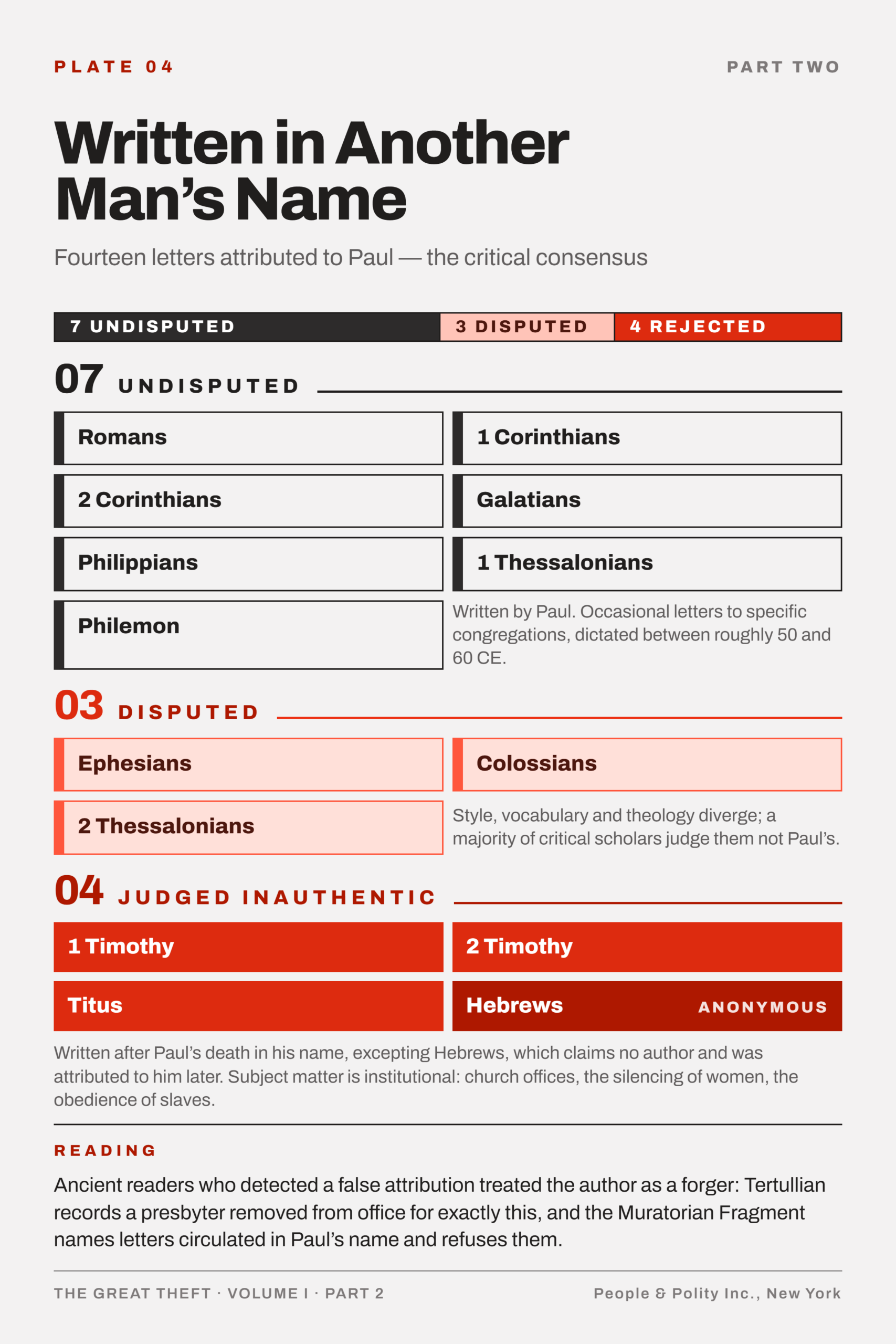
Six letters in the New Testament carry names their authors did not own. Ephesians, Colossians, and 2 Thessalonians are disputed among scholars; the three Pastoral Letters, First and Second Timothy and Titus, are judged false by a large majority; 2 Peter is rejected almost without argument. Notice which letters these are. Instructions on church office, on bishops and deacons, on women keeping silent, on slaves obeying their masters, sit heavily in the documents whose authorship fails. The material that built the institution and disciplined the people inside it is the material most likely to have been written by someone other than the apostle whose name it bears.
Internal evidence carries the finding, not suspicion. About a third of the words in the Pastoral Letters never appear in the undisputed letters of Paul, and much of that vocabulary belongs to Christian usage of the second century. The church offices those letters describe reflect an organized clergy that did not yet exist while Paul was alive. In 2 Peter the writer leans on the letter of Jude, copying from it, and then speaks of a collection of Paul’s letters as though it were already established scripture, a state of affairs decades away when Peter is supposed to have died. The writer also promises to leave his readers a reminder after his death and warns them against scoffers who ask why the promised return of Christ has not come, a worry that belongs to the second generation of the church rather than the first. A fisherman executed under Nero did not write Greek of this polish, and did not live to see the delay he is made to explain.
Irony sits at the center of the pile. In 2 Thessalonians the readers are warned not to be shaken by any letter claiming to come from Paul, and near the end the writer points to his own handwriting as the mark of a genuine letter. A document that much of the field judges false thus instructs its readers in how to detect a false document. Whoever wrote it understood exactly what was circulating and exactly how much a name could carry.
Beyond the canon the volume grows larger and stranger. A letter to the Laodiceans and a third letter to the Corinthians both moved under Paul’s name, the second holding scriptural standing in the Armenian church for a time. Fourteen letters purporting to pass between Paul and the philosopher Seneca were forged in the fourth century and taken as real by Jerome, who listed Seneca among Christian authors on their strength. A body of mystical theology written around the year 500 by an anonymous Syrian was attributed to Dionysius the Areopagite, the Athenian convert named in the book of Acts, and that false name gave a writer working five centuries after the apostles a near-apostolic authority over Western thought, cited by Thomas Aquinas more than a thousand times before the fraud was exposed.
Fighting forgery with forgery became normal, which shows how deep the practice ran. Documents were faked to answer positions advanced in other faked documents, so that rival parties within the same religion fought each other with fabricated apostolic authority on both sides. Third Corinthians exists to refute teachings its opponents were themselves pushing under Paul’s name. Neither side in an exchange like that can be called an innocent heir to literary custom. Both knew what a signature was worth, which is why both were willing to take one. The lesson the early church drew from this was not to stop forging but to forge more carefully, and the tests scholars now use to expose the fakes were first sharpened by ancient readers trying to expose the fakes of their rivals.
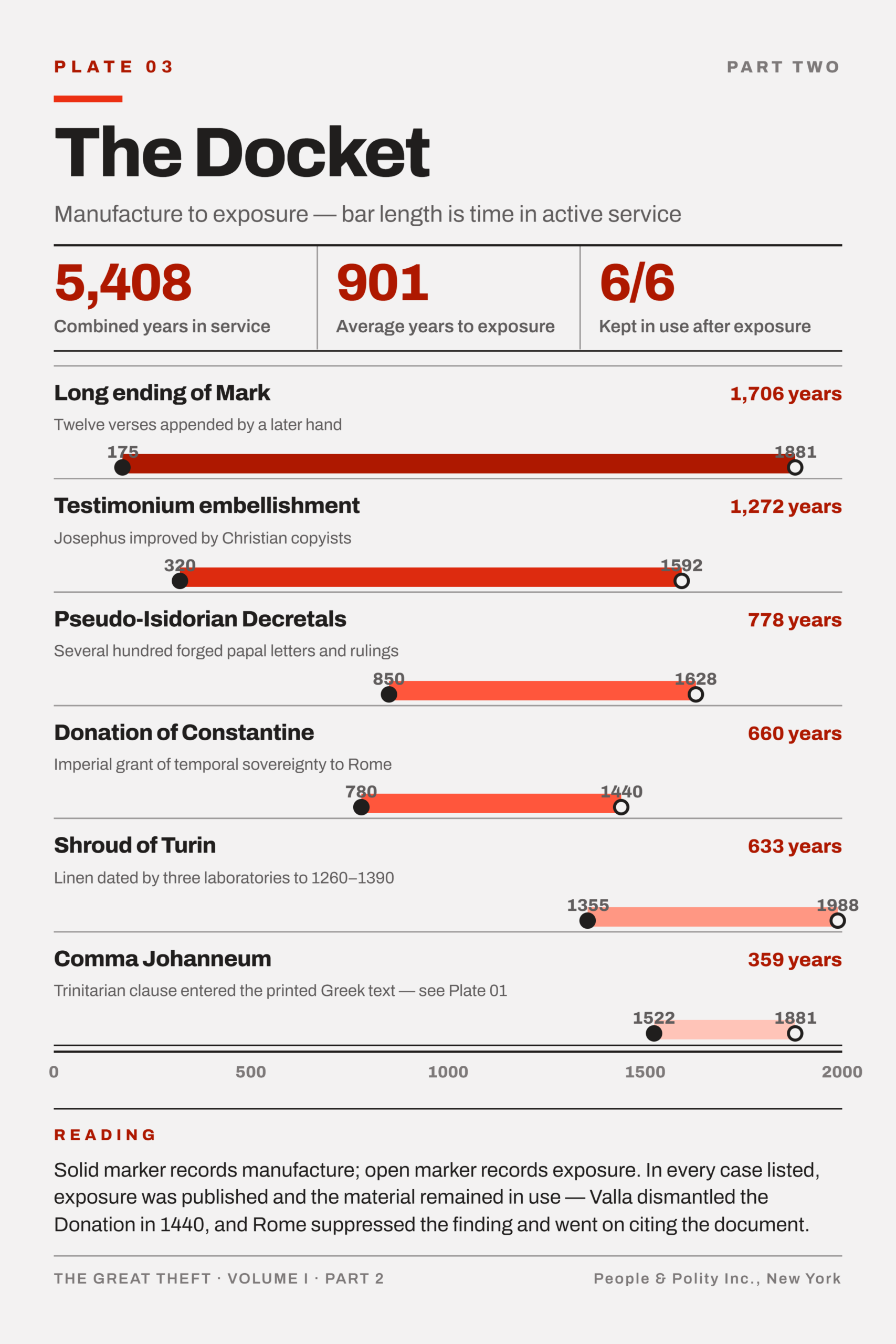
Insertion is a second category, separate from false authorship and easier to prove. A sentence stating the Trinity, absent from every Greek manuscript before the fourteenth century, entered the printed Greek text in 1522 and passed into the King James Bible. Twelve verses carrying the risen Jesus were added to the end of Mark by a later hand. Two verses ordering women to keep silent shift position in the manuscripts of First Corinthians, the behavior of a margin note absorbed into the text. The story of the woman caught in adultery belongs to no early copy of John and wanders through several locations before settling where it now rests.
Beyond scripture the record widens and the motive sharpens. Christian copyists worked over the passage in the Jewish historian Josephus that mentions Jesus, adding confessional lines no first-century Jew would have written, so that specialists now reconstruct an honest core beneath a scribal embellishment. That is a polite way of saying someone improved the evidence.
Whole institutions ran on manufactured documents. The papacy’s claim to worldly power rested for centuries on the Donation of Constantine, a forged imperial grant in which the emperor supposedly handed Rome dominion over the Western empire. Church law absorbed a ninth-century collection of several hundred forged papal letters and rulings, assembled to shield bishops and centralize authority, and those forgeries shaped the law long after their nature was known. Lorenzo Valla proved the Donation false in 1440 by reading its Latin and finding words that did not exist in the fourth century, along with titles and offices that had not yet been invented when Constantine supposedly wrote. Rome suppressed his finding and went on using the document for another hundred years, because the forgery underwrote territory, revenue, and the papal claim to stand above kings.
Suppression completes the list, and its clearest object was printed in London in 1807 for use among enslaved people in the British West Indies. The editors cut about nine-tenths of the Old Testament and half the New. Exodus, the story of a people led out of bondage, was removed entire. Retained was the instruction that servants obey their masters with fear and trembling. Nobody forged a word in that volume. The deception was done by deciding what would not be read.
Relics belong in the same file. Three independent laboratories dated the linen of the Shroud of Turin to between 1260 and 1390, which matches both its first appearance in the 1350s and the memorandum in which a bishop told the pope in 1389 that the artist who painted it had confessed. Veneration continued. Exposure and abandonment, it turns out, are unrelated events.
Defenders of these letters hold that pseudonymous writing was an accepted convention of the ancient world, that a disciple writing in his teacher’s name meant honor rather than fraud, and that judging first-century texts by modern rules is anachronism. The ancients answer it themselves. Tertullian’s presbyter lost his office. An early list of accepted books names letters forged in Paul’s name and rejects them. Salvian was summoned to explain himself, and Galen protested in print. Ancient readers who caught a false name treated the writer as a liar, not an heir. A second objection deserves the same reply: that most manuscript variants are trivial, which is true and conceded. What is at issue is the small remainder that does the work of building churches and silencing people.
Nothing in this file requires that the first believers lied about what they had experienced. Grief and vision account for the beginning without a single deceiver, and the argument is stronger for not needing one. Deception enters afterward, once a movement holds property, offices, and enemies, and it enters through people who had already decided the truth needed help. Valla published in 1440 and changed nothing for a hundred years, which is the shape of the whole record: exposure, then silence, then the forgery kept in service because the people who would object are never told.
Sources for this part appear in the Evidence Docket at the close of this volume.
Forensic Plates
A full evidence docket for this volume, with every source and citation, is compiled as a separate PDF released at the close of the volume.
