

It’s not the kitschy White House ballroom—it’s logistics warehouses converted to ICE detention centers.
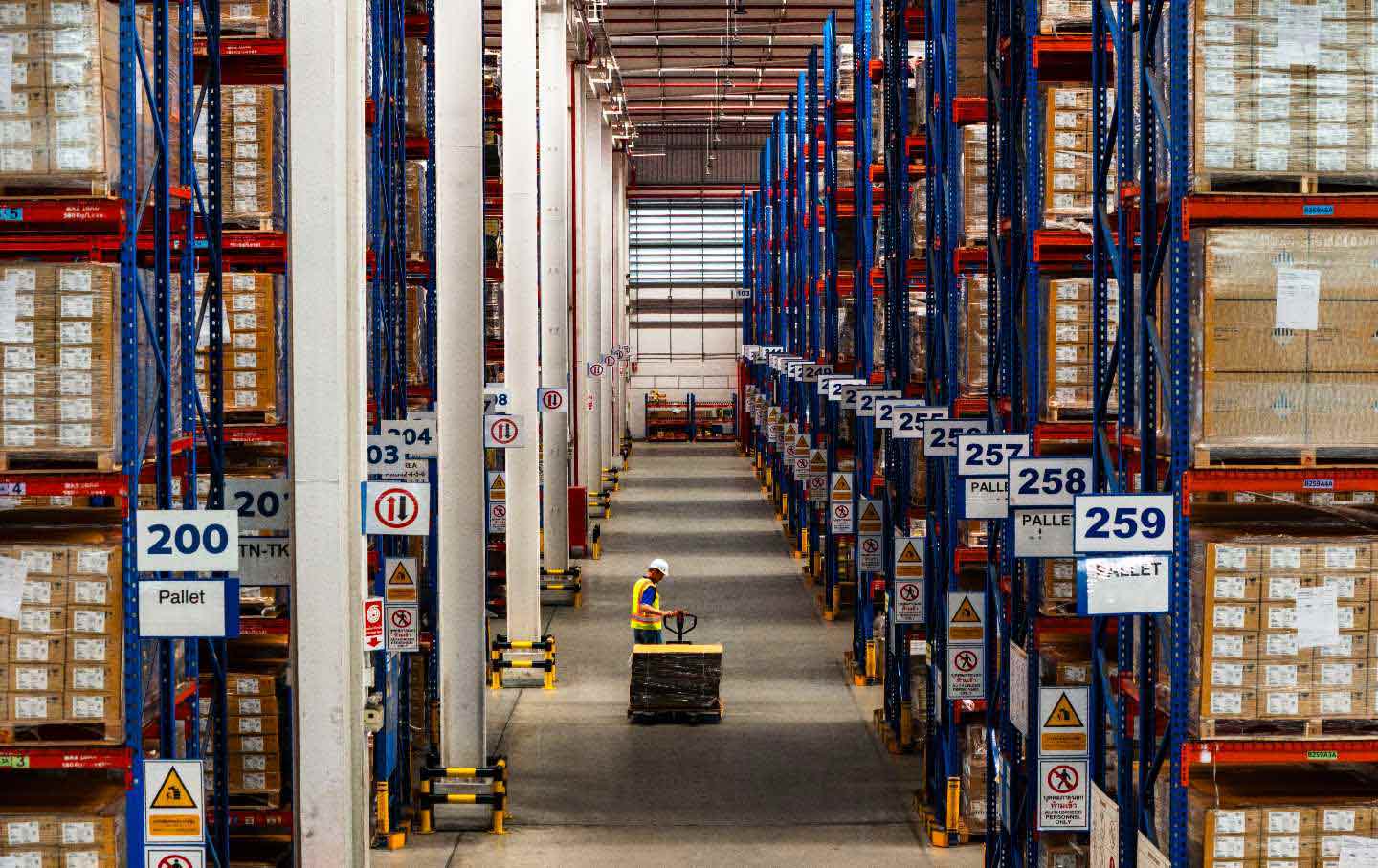
When Congress voted to expand the budget of Immigration and Customs Enforcement by $170 billion last July, it was inevitable that some of that money would be spent reshaping the built environment toward new and more sinister ends. Sure enough, by the end of 2025, ICE released plans to convert seven massive logistics warehouses scattered across the United States into detention centers to hold more than 80,000 detainees. Another 16 will be used as immigrant-processing sites. Turning warehouses for storing goods into warehouses for storing people is already harrowing. The historical precedents for repurposing industrial infrastructure to forcibly transport humans at scale make it even more so.
Perhaps more than any other type of structure, including Donald Trump’s various flights of fancy in Washington, DC, these warehouses are shaping up to be the clearest expression of fascist architecture in our time. They tick all the boxes, offering surveillance, confinement, and monumentality. One of the fascists’ chief innovations was using industrial techniques to execute their program of mass displacement and murder. So too must our government’s most violent elements use the structures and flows already available to them to achieve the disenfranchisement and total social control they seek. “We need to get better at treating this like a business,” said Todd M. Lyons, ICE’s acting director, at a border-control conference earlier last year. The administration’s goal, in Lyons’s words, is to deport immigrants as efficiently as Amazon moves packages: “Like Prime, but with human beings.”
As the factories of old rot along railroad corridors (as any frequent Amtrak passenger can tell you), their successors dot the peripheries of airports or haunt stretches of empty highway. These sprawling logistics centers are the result of an economy based on the hub-and-spoke model, a distribution system in which the delivery of goods is centralized around a strategic site to mercilessly optimize for speed. Many of them are erected in seemingly random and isolated places. ICE plans to convert the centers in Trump strongholds like Social Circle, Georgia, and Baytown, Texas. These warehouses are way stations for the millions of packages that circulate through the United States every day.
Logistics warehouses are exceedingly simple, and their construction resembles a barn-raising: Their massive concrete walls are poured in place and propped up on stilts. One side features 10 or more huge bays opposite an entrance; the other sides are bleak expanses of windowless concrete. Presumably ICE will brick up the bays, making the interior into a permanent nighttime. As an architectural typology, these buildings are among the simplest and most inflexible. Despite being so anonymous-looking, their forms reveal a great deal about our world: how flows of capital and labor disappear into a far-off location and reappear on our doorsteps in neat little packages removed from the toil of production; how we’ve devised this process to be as unobtrusive and convenient as possible; how the human element in all this should be kept hidden from view at all times, so much so that contact with the world outside the box is as impermissible as light.
Already, in their current iterations, these centers are fundamentally not designed for people. They are built to spec for the company that leases them and outfitted to that company’s needs. Logistics is now remarkably automated and is only becoming more so, with most of the work of scanning and sorting packages done by a computer. A smaller warehouse may be staffed by only a dozen or so people. A package is not supposed to sit at a logistics center for long; these buildings are intended for processing, not storage. That’s why most of them don’t have robust climate control.
Current Issue

Alarming reports from inside Amazon warehouses, for example, already cite the lack of air conditioning as a major concern for the workers there, who spend eight or more hours a shift cooled only by a few floor fans. Replace packages with thousands of human bodies and add in the heat and humidity of places like Texas and Georgia, and you are looking not only at an architecture of containment, but one from which many may not emerge. Furthermore, these centers—especially those in rural or exurban areas—often lack access to main water lines and power grids, which poses obvious dangers when holding as many as 2,000 people. Out-of-the-way locations make it easier to keep those people out of sight and away from communities who could come to their aid. It also makes them easier to surveil. According to The Washington Post, ICE claims that the newly outfitted warehouses will be adequately furnished with things like restrooms and recreation centers. But given that current detention centers are already impenetrable, how will we know?
One of the great historical misconceptions in how we think about fascist architecture is the focus on the public buildings above all else. The unbuilt rotundas of Hitler’s architect, Albert Speer; the sparse modernist bays of Giuseppe Terragni’s Casa del Fascio in Como, Italy; and now, Trump’s quixotic ballroom and his even more quixotic plans to build an Arc de Triomphe in downtown DC—these are the accoutrements by which the fascists themselves wish to be remembered. But the real architectural legacy of fascism is the structures used to carry out their most unconscionable plans. Many of these sites have since been torn down or memorialized in the form of museums, most famously in the case of Auschwitz-Birkenau, which is part of why that legacy endures so strongly in the public memory. The fascist built environment is often not considered architecture as such but mere infrastructure. This is a huge mistake. We should not be so unwise as to make it again.
