

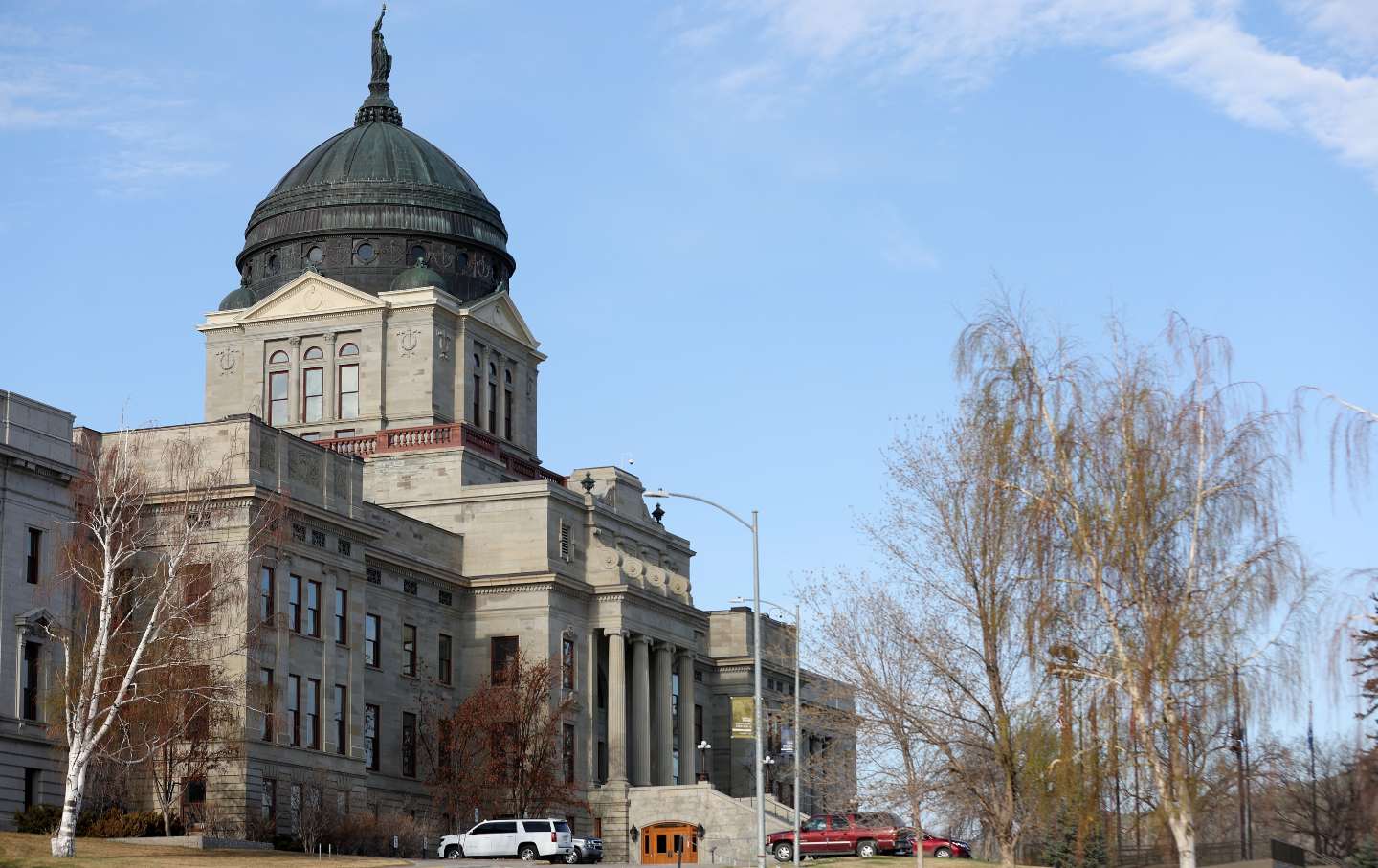
A transpartisan initiative to return power to the people.
Montana, like so many rural states, was less than a generation ago a place where political candidates had to meet voters and talk with them to win an election. In the 16 years since the US Supreme Court’s Citizens United decision opened the gates to allow corporate money to flood and overwhelm the political system, much of that personal engagement has evaporated.
Voters’ mailboxes bulge with election ads from groups with unfamiliar names; television and radio are overwhelmed with paid political spots and attack pieces. But the candidates themselves—and their positions on issues—can be much harder to locate. In a place where politicians once made getting to know their voters across vast distances a sport, statewide elected officials often spurn town halls and skip public events in favor of private fundraisers. The result is a distanced, disenchanted electorate, frustrated that its concerns go unheard, and a slate of electeds who seem to primarily serve their donors.
For citizens like Todd Frank, owner of an outdoor sports business in Missoula, it’s time for something to give. Frank grew up in Montana, and like most school kids here learned from an early age about the history of toxic political corruption and money that shaped the state’s earliest, dark days. In the current environment, he said, it feels like the system is repeating its worst mistakes from a century ago.
“I don’t think our elected officials do a good job of listening to their constituents, because they are listening to the people who give them millions and millions and millions of dollars. We could do so much better,” said Frank. “The frustration among the average voter is about the amount of money in politics.”
Frank is one of many Montanans speaking out in favor of a new initiative that could upend the power of money in politics, an all-volunteer effort to make Citizens United irrelevant, that is drawing attention and endorsements from high-profile figures and sparking similar efforts across the country. The Montana Transparent Election Initiative would prohibit any incorporated entity that operates within the state from spending to influence state, federal, or local elections. It doesn’t attack Citizens United head-on but rather makes it meaningless, organizers say. The prohibition would apply to all corporations, for-profit and nonprofit, as well as unions, a seemingly simple workaround to what many see as the primary rot in American politics.
Jeff Mangan, Montana’s former commissioner of political practices, said the election initiative and the larger slate of ideas known as the Montana Plan are rooted in history and essential for returning power to the people. Mangan developed the initiative and larger plan with a constitutional law scholar and has become the key organizer shepherding it onto the ballot with support that crosses party lines. It’s been a journey involving extended court battles and quiet but powerful opposition from groups who wield power through organized political spending, but the initiative has strong public support in polls.
Current Issue
Mangan is optimistic that the plan will finally go before voters on the November ballot, but he said even the conversation it has created in getting there is important and necessary. The pressure on elected officials to raise money while in office is immense and detracts from their ability and desire to engage with constituents. By one estimate, a typical sitting US senator needs to raise $16,200 in campaign funds every day in office.
“When you’re looking at having to spend or to raise that kind of money to be competitive, where is your focus going to be? It’s going to be talking to the donor,” said Mangan. “We can make money not the focus of these races anymore, and put the focus where it should be, the citizen, the voter, regardless of party.”
Most recently, former US transportation secretary and 2020 Democratic presidential hopeful Pete Buttigieg weighed in to support the plan, and he will travel to Montana on May 17 to speak about it in Butte, once the dark heart of Montana’s political corruption.
“Americans don’t have to accept a system where absurd amounts of corporate and dark money drown out their votes,” Buttigieg said in a statement on the election initiative. “A change to the law could ensure that elected leaders are more accountable to the people, which means a chance to finally break through and deliver on key issues from housing to health care.”
Marc Racicot, former two-term Republican governor of Montana and ex-chair of the Republican National Committee, said Citizens United and its resulting deluge of corporate money has divorced politicians from those who elect them to office. When he first ran for office in the 1980s and ’90s, talking to voters and hearing their concerns was at the heart of the endeavor. In his successful run for governor in 1993, he and his Democratic opponent held dozens of debates across the state, an experience he said sharpened his focus on what issues mattered to the people he went on to represent.
“You learn what it is that the people you are so determined to serve have in terms of expectations,” he said. “You had to do something to earn the trust of the people you wanted to serve.”
Racicot, who has been rebuked by the Montana Republican Party for criticizing President Trump, is backing the initiative, crisscrossing the state for packed town halls and talks along with other supporters.
Former US labor secretary and political commentator Robert Reich jumped in to support the plan earlier this year, in a video complete with cowboy hats and yeehaw spirit.
“We can get rid of Citizens United,” said Reich. “A very unlikely state is leading the way.”
From the outside, it might seem odd that a state that now votes reliably Republican, where Trump is still popular, is hatching this plan. But Montana, often a little bit radical and politically unusual, could be the likeliest state of all to attempt to push back against big money in politics. It has a century-plus history of leading the way in this fight, born of its earliest days as a resource colony controlled by copper barons and political corruption.
In 1899, Montana Copper King William A. Clark, a Gilded Age industrialist who owned a series of mines in Butte, spent an estimated $431,000 to bribe his way into the US Senate, primarily by paying off state legislators for their votes. Clark, who would declare, “I never bought a man who wasn’t for sale,” was later elected and served in the Senate from 1901 to 1907, but his real legacy lay for decades in state campaign law and an amendment to the US Constitution.
His corruption was so epic that it drew the scorn of Mark Twain, who, in a 1907 essay wrote, “He is as rotten a human being as can be found anywhere under the flag; he is a shame to the American nation, and no one has helped to send him to the Senate who did not know that his proper place was the penitentiary, with a ball and chain on his legs.”
Popular
“swipe left below to view more authors”Swipe →
The Clark scandal would help lead to the adoption and ratification of the 17th Amendment to the US Constitution in 1911, which, in part, mandated the direct election of senators by citizens, not state legislators.
On the back of Clark’s corruption, Montana voters took their concerns directly to the ballot. In 1912, the voters of Montana approved one of the nation’s earliest and longest-held bans on corporate money in politics, with an initiative that created campaign spending limits.
The ban held for a century. In 2011, in a landmark case that was among the first to challenge Citizens United, the Montana Supreme Court offered a history lesson in a ruling on corporate spending in elections.
“At that time the State of Montana and its government were operating under a mere shell of legal authority, and the real social and political power was wielded by powerful corporate managers to further their own business interests,” Chief Justice Mike McGrath wrote for the court, explaining the 1912 landscape.
The US Supreme Court did not agree, and Montana’s last stand against corporate money in politics was overturned. Now the state is trying once again to upend how money controls politics.
As with most things in the political realm, even ballot initiatives have become big business. Montana is a massive state with a relatively low population of just over a million people, and law requires that the roughly 60,000 voter signatures come from across the state. Most hire firms to collect signatures, a move that would cost the Transparent Election Initiative close to $1 million. Mangan is instead spearheading an all-volunteer effort. It’s tougher and less certain, he said, but paying a company to gather signatures to curb money in politics would be against the spirit of the movement.
Former RNC chair Racicot is helping lead the charge, as part of what he sees as essential to shoring up democracy.
“If we get money out of politics, we will see a refocus of our priorities,” he said
From illegal war on Iran to an inhumane fuel blockade of Cuba, from AI weapons to crypto corruption, this is a time of staggering chaos, cruelty, and violence.
Unlike other publications that parrot the views of authoritarians, billionaires, and corporations, The Nation publishes stories that hold the powerful to account and center the communities too often denied a voice in the national media—stories like the one you’ve just read.
Each day, our journalism cuts through lies and distortions, contextualizes the developments reshaping politics around the globe, and advances progressive ideas that oxygenate our movements and instigate change in the halls of power.
This independent journalism is only possible with the support of our readers. If you want to see more urgent coverage like this, please donate to The Nation today.
More from The Nation
In this week’s Elie v. US, our justice correspondent explores the GOP’s glee over the Supreme Court’s Voting Rights decision. Plus: Elie’s take on Musk v. Altman.
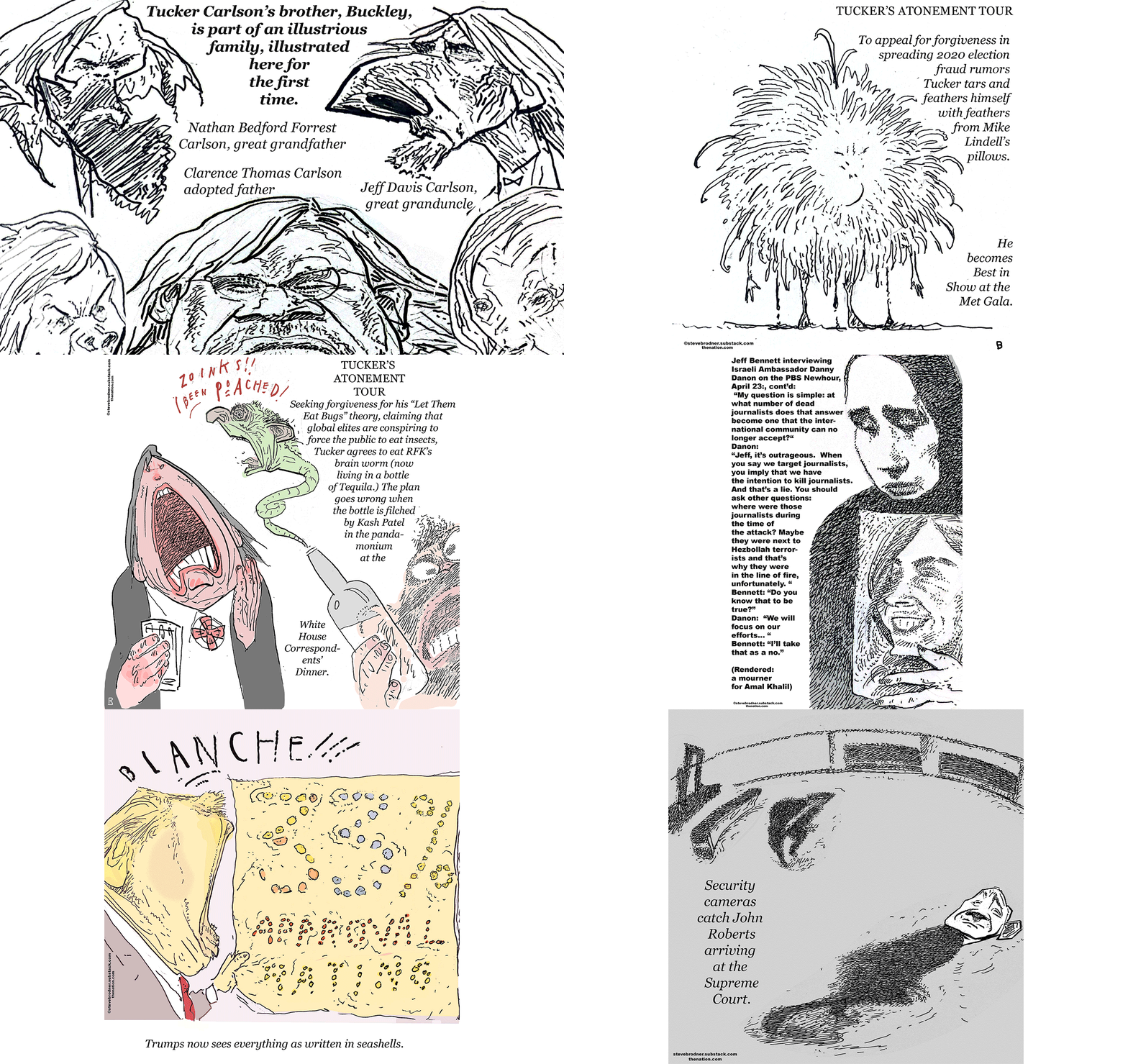

DNC chair Ken Martin has turned himself into the shifty bad guy from Fargo.
Increasingly unpopular and facing a fracturing coalition, Trump is using government power to punish his critics, take political revenge, and revel in his own cruelty.
